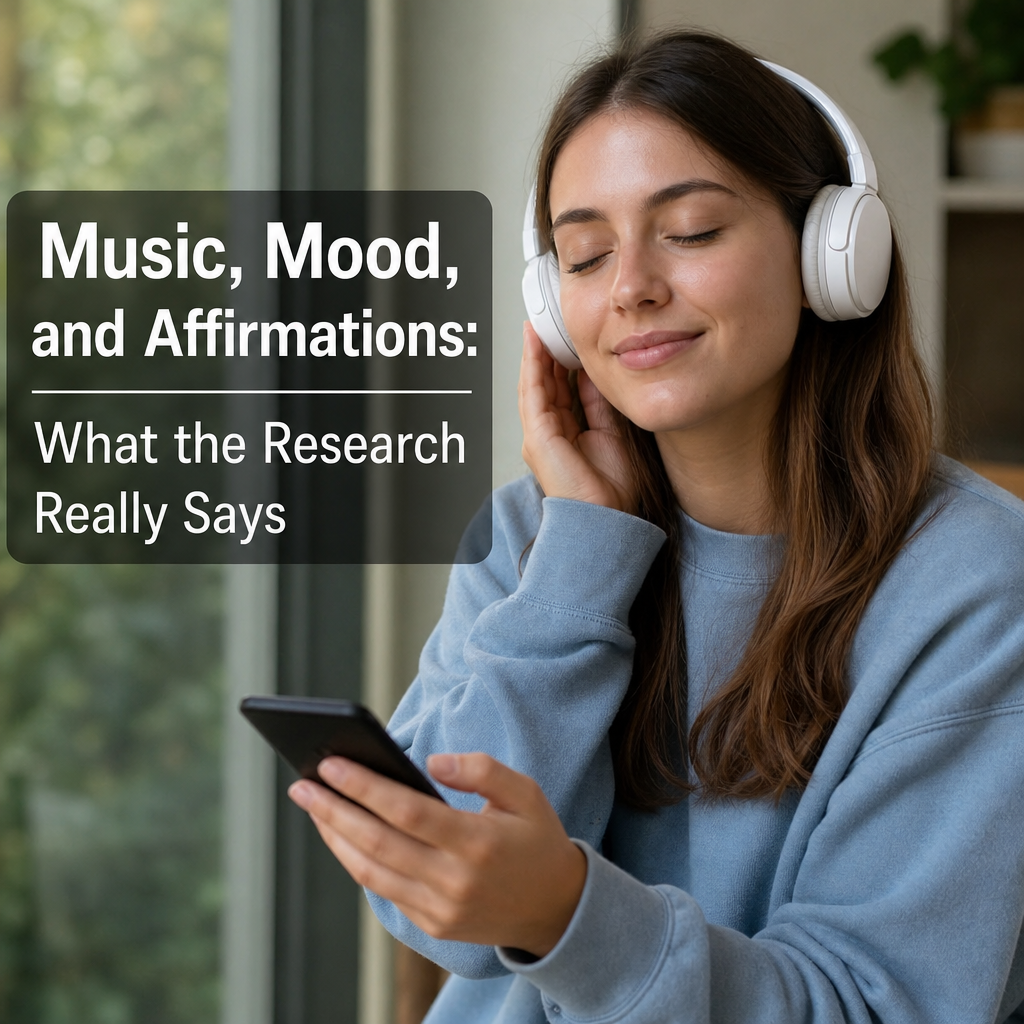
Most of us know the feeling. A certain song comes on and your shoulders drop, your breathing slows, and for a few minutes the world feels a little kinder. Affirmations aim for something similar: a few words that help you feel steadier and more like yourself.
At Ageless Regeneration, we bring the two together. In this article we look at what science says about music and mood, what it says about affirmations, and why the combination makes sense. We’ll also share one surprising research finding that changed how we write our songs.
Music can help the body relax
This is one of the best-studied areas in music research. In 2020, a research team led by Martina de Witte combined the results of 104 randomized controlled trials, with more than 9,600 participants, into one large analysis. They found that music interventions reduced stress in both the body and the mind. The effects on body measures like heart rate, blood pressure, and stress hormones were small to moderate, and the effects on how stressed people felt were moderate. Heart rate showed the clearest change.
A second analysis by the same team looked at music therapy led by trained music therapists and found even larger effects on stress. That suggests music chosen and used with intention may help more than music playing in the background.
In plain words: music is not magic, but it is a real, measurable way to help your body settle. That is a lovely foundation for an affirmation practice.
Music lights up the brain’s reward system
Why does a beautiful passage of music give us chills? In a well-known 2011 study published in Nature Neuroscience, Valorie Salimpoor and colleagues at McGill University used brain scans to watch what happens when people listen to music they love. They found that pleasurable music released dopamine, a brain chemical tied to reward and motivation, in a part of the brain called the striatum. Even the anticipation of a favorite moment in a song triggered dopamine, in a slightly different area.
The researchers described this as one of the first demonstrations that an abstract pleasure like music can engage the same reward chemistry as more basic rewards. It helps explain why music can feel so uplifting, and why we want to come back to songs we love.
Affirmations engage the brain’s reward system too
Here is where it gets interesting. Two research teams published brain imaging studies in 2016 looking at self-affirmation, which in psychology usually means reflecting on the values and qualities that matter most to you.
- Christopher Cascio and colleagues at the University of Pennsylvania found that when people reflected on their core values, especially with an eye toward the future, brain areas tied to self-reflection and reward became more active. That activity also predicted who later became more physically active in a follow-up program.
- Janine Dutcher and colleagues at UCLA found that self-affirmation activated the ventral striatum, a key reward area, in both college students and a community sample.
So music and meaningful affirmations both appear to involve the brain’s reward circuitry. That is part of why pairing them makes sense. We want to be careful here, though: no study has yet tested affirmation songs directly. The connection is a reasonable idea built on two separate sets of findings, not a proven result.
The surprising finding everyone should know
In 2009, psychologist Joanne Wood and her colleagues published a study with a title that stopped many people in their tracks: “Positive self-statements: Power for some, peril for others.”
They asked people to repeat the phrase “I am a lovable person.” People who already felt good about themselves felt a little better afterward. But people with low self-esteem actually felt worse. The researchers believed that when a statement feels untrue, the mind pushes back with contradicting thoughts, like “No, I’m not.” Interestingly, people with low self-esteem did better when they were allowed to think about ways the statement was both true and not true.
This is important, and it is also good news, because it shows how to make affirmations work better. Notice the difference between the two kinds of affirmations studied above. The brain imaging research used values-based reflection, thinking about what truly matters to you. The study that backfired used a sweeping claim that some people didn’t believe.
How we use this in our songs
These findings shape how we write affirmation music:
- Gentle, believable words. Lines like “I can begin again, gently, with one kind choice today” invite you in instead of asking you to believe something that feels out of reach.
- “I am learning” and “I am open to.” Words that describe a direction, not a finished result, tend to meet less inner resistance.
- Values and care, not perfection. Songs about kindness, rest, gratitude, and caring for your body connect with what matters to you.
- Music that calms first. A relaxed body and an enjoyable melody may make it easier to receive kind words.
How to use affirmation music well
- Choose songs whose words feel true, or almost true. If a line makes you argue with it, that song may not be the right one for you right now, and that’s okay.
- Change a word if you need to. Sing “I am learning to rest” instead of “I am completely at peace.” The melody still carries it.
- Use music to settle first. Listen once just to relax, then listen again paying attention to the words.
- Let it be enjoyable. The reward response to music is part of the benefit. If you don’t like a song, try another.
- Keep it alongside real support. Affirmation music can be a comforting part of self-care. It is not a replacement for friends, family, counseling, or medical care.
You can explore all of our affirmation songs here, each with the full words written out so you can see whether they feel right for you. If you’d like to understand why songs are so easy to remember, read our companion article, Why Affirmations Stick When You Sing Them.
This article is for general information and reflection. It is not medical or mental health advice. If you are struggling, please reach out to a health professional or someone you trust.
Sources
- de Witte, M., Spruit, A., van Hooren, S., Moonen, X., & Stams, G.-J. (2020). Effects of music interventions on stress-related outcomes: a systematic review and two meta-analyses. Health Psychology Review, 14(2), 294-324.
- de Witte, M., et al. (2022). Music therapy for stress reduction: a systematic review and meta-analysis. Health Psychology Review, 16(1), 134-159.
- Salimpoor, V. N., Benovoy, M., Larcher, K., Dagher, A., & Zatorre, R. J. (2011). Anatomically distinct dopamine release during anticipation and experience of peak emotion to music. Nature Neuroscience, 14, 257-262.
- Cascio, C. N., et al. (2016). Self-affirmation activates brain systems associated with self-related processing and reward and is reinforced by future orientation. Social Cognitive and Affective Neuroscience, 11(4), 621-629.
- Dutcher, J. M., et al. (2016). Self-affirmation activates the ventral striatum: A possible reward-related mechanism for self-affirmation. Psychological Science, 27(4), 455-466.
- Wood, J. V., Perunovic, W. Q. E., & Lee, J. W. (2009). Positive self-statements: Power for some, peril for others. Psychological Science, 20, 860-866.